Migrating from Claude Code to Codex - motivation and day one
I’ve been using Claude Code for a long time. Over time, it became my main development tool. I built skills, plugins, memories, and CLAUDE.md files around it across my projects. Everything works very well… so I decided to change it 🙃
For the next month, I’ll work mainly with OpenAI Codex. At first, both tools will run side by side. Will they get in each other’s way? I don’t know. Will I make a mess across my repositories? Quite possibly. But I have to start somewhere.
TL;DR - read the article in 30 seconds
- Codex feels faster, and its limits last longer with a similar workflow.
- The import handled most of my setup; shared repositories needed one additional
AGENTS.mdstep. - OpenAI takes a better approach to third-party tools: OpenClaw can authenticate with a ChatGPT/Codex subscription instead of billing every API call separately.
- Early signs suggest comparable code quality, but the real test is still ahead.
The first obvious question - why?
Several reasons piled up: curiosity, the approach to third-party tools, and increasingly positive feedback. None would probably have been enough on its own. Together, they were enough. So… let’s go 🚀
I want to learn a new tool
There is no grand philosophy here. Codex is developing quickly, and as a fan of innovation, I want to test it in practice. Reading yet another “Claude Code vs Codex” comparison won’t tell me how it handles my repositories, rules, and workflow. A month of using it will.
Better policy
OpenAI takes a much better approach to third-party tools. One example? You can authenticate OpenClaw with a ChatGPT/Codex subscription without paying separately for every API call. Claude chose a different path here. So did I.
Increasingly positive feedback
Not that long ago, I wasn’t considering Codex at all. Worse, I was actively against it - I ignored OpenAI’s product and strongly favored Anthropic. Claude worked well, so every new piece of information about Codex was easy to dismiss with a shrug.
Eventually, there were too many positive reports about speed, code quality, and limits to keep pretending I couldn’t see them.
First day, first observations
Reasons are one thing. Eventually, you have to launch the tool and give it real work. My first proper day with Codex went suspiciously well. Not the most convenient result for someone who had spent a long time pretending OpenAI had nothing interesting to offer.
A free month
I had paid for an OpenAI subscription before, but later dropped it and stuck with Claude. When I checked back after a longer break, a free month of ChatGPT Plus was waiting on my account. Free is a fair price.
At first, I barely used it myself. Plus mainly served as the backend for my OpenClaw, which helps me with simple everyday tasks. Claude still won for coding. Over the last few days, however, its limits started disappearing noticeably faster. Work on one of my projects, Fable, burned through my weekly limit by the middle of the week. By Wednesday, I was out of tokens - and that was when OpenAI started filling the gap.
The free month of Plus saved my ass. Eventually, I bought a paid Codex subscription and canceled Claude Max 5x. I still have four days left, but it won’t renew.
It is faster
Codex and ChatGPT generate answers and code noticeably faster than Claude in my day-to-day work. I didn’t measure it with a stopwatch because I have more interesting things to do, but I can feel the difference on practically every task. Less time watching the generation animation, more time working. Good deal.
The limits last longer
With a similar workflow, Codex’s usage limits drain much more slowly than Claude Code’s. Both tools use a five-hour session window. Right now, Claude can burn through mine in about an hour, while Codex sometimes lasts for the entire window under a similar workload.
Both plans carry a “5x” label, but it isn’t a shared unit. OpenAI publishes model-dependent ranges: Pro 5x currently includes, among others, 75-450 local messages per 5 hours with GPT-5.6 Sol and 100-550 with GPT-5.6 Terra. Additional weekly limits may also apply, although OpenAI does not publish their exact values.
Anthropic currently says that Max 5x provides five times the Pro capacity per session. The session limit resets every 5 hours, while a separate weekly limit is shared across Claude and Claude Code. The company no longer publishes one exact prompt count for Max 5x. So “5x vs 5x” looks neat in a table but doesn’t tell you how much real work either plan will complete. We’ll test that 😉
I’ll run a more precise comparison next week using the same concrete task. I track usage with CodexBar, built by the creator of OpenClaw. It shows both five-hour and weekly limits for the two tools, and it works remarkably well.
See the current CodexBar reading
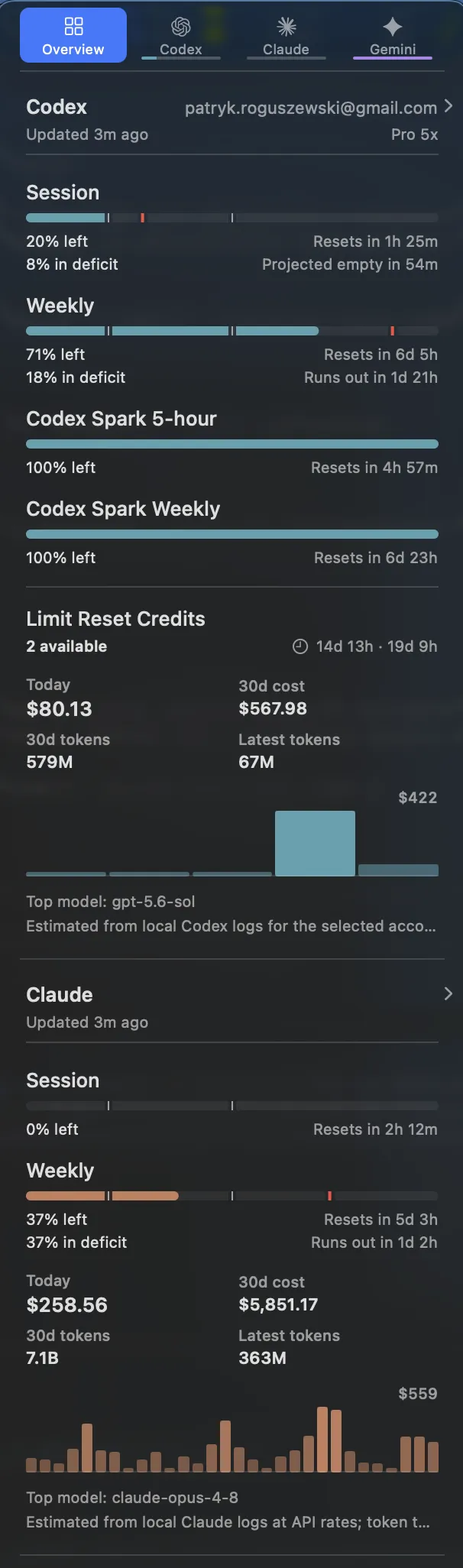
We’ll see whether that picture holds for the whole month. The first productive day looked very promising.
Migration was suspiciously easy
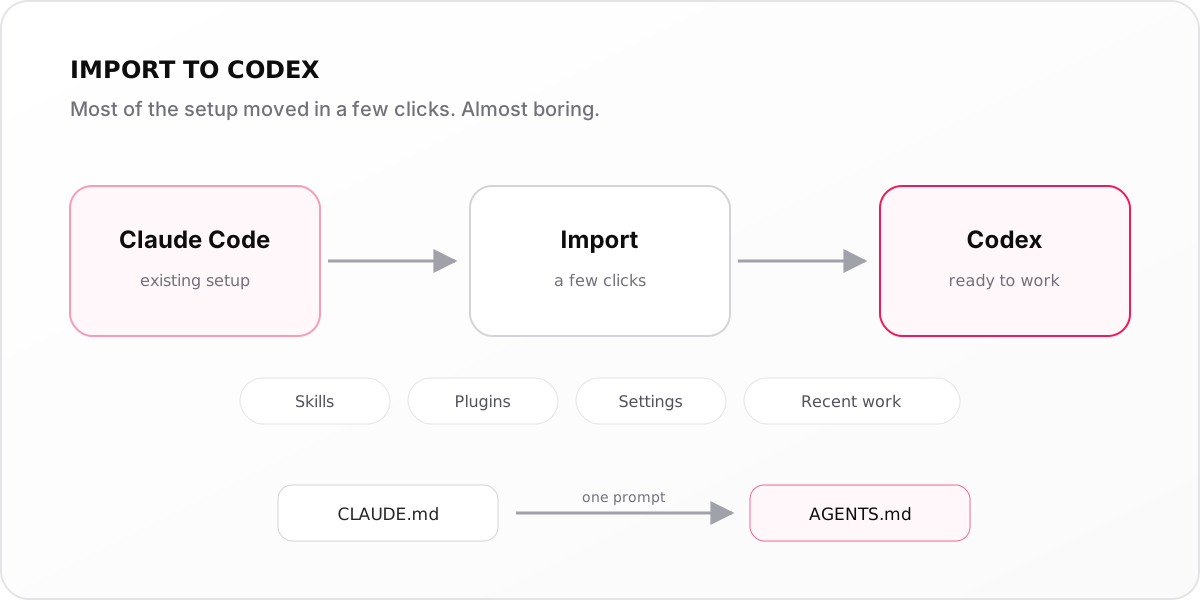
I expected to move the configuration manually. There was no need. OpenAI added a graphical “Import to Codex” flow to the ChatGPT desktop app, with support for Claude Code configuration. I used that - no commands and no moving files around by hand.
The migration covered skills, plugins, settings, and recent work. A few clicks later, most of my existing environment was ready. Almost boring.
There was one problem. Shared repositories did not get equivalents of their CLAUDE.md files. One prompt later, Codex analyzed the projects and prepared AGENTS.md files for them. Problem solved.
I don’t have to relearn how to work
I mainly use Codex CLI. Moving from Claude Code required no change in habits: I open a repo, describe the task, and the agent analyzes files, makes changes, and runs tests.
The familiar features are there too. Sessions can be resumed with codex resume. There is also an equivalent of --dangerously-skip-permissions: --dangerously-bypass-approvals-and-sandbox, for people who enjoy long flags and living on the edge. Thankfully, there is also a --yolo alias.
The learning curve? Practically nonexistent.
Code quality is comparable
This was the most important point for me. Faster answers and higher limits mean nothing if I have to fix half of the generated code afterward.
So far, the quality is comparable to Claude Code. Well-prepared AGENTS.md files were enough for Codex to understand the project structure, commands, and my expectations. The first changes were on par with what I was getting before.
The first score
If I’m comparing two tools, there has to be a table. Otherwise, the internet might refuse to recognize the comparison.
| Area | Claude Code | Codex | Result |
|---|---|---|---|
| Speed | Noticeably slower | Answers and code appear faster | Codex |
| Limits | A weekly limit could disappear halfway through the week | They drain more slowly with similar usage | Codex |
| Code quality | High and proven over a long period | Still testing | In progress |
| Policy | More restrictive approach | OpenClaw works with a ChatGPT/Codex subscription | Codex |
After the first productive day: Codex 3:0 Claude. Code quality still needs more time.
What next?
I paid for a month, and I’ll stay with Codex during that time. For the first few days, I’ll continue using both tools so I can compare them on the same types of tasks.
I’ll share the next observations around the middle of the subscription. The final part will come at the end of the month - by then, we’ll know whether this was a migration or just a longer affair with a new tool 😉
Tags